
The Space Between: Learning to Rest in the In-Between
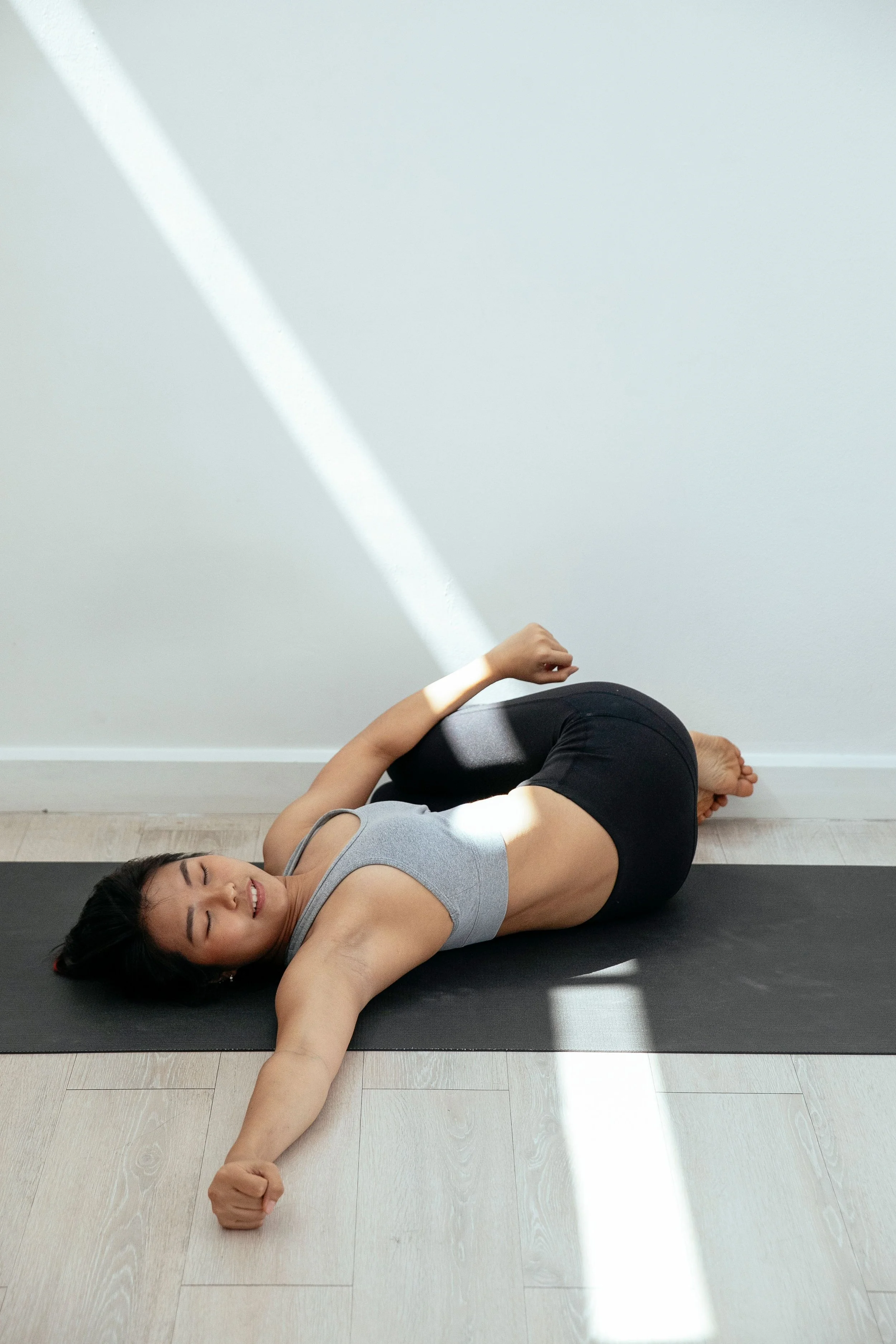
What Side Lying Pose can teach us about life’s In-between moments.
The final days of August sit beautifully at a threshold between what has been, and what is yet to come. Summer isn’t quite gone, September is beginning to make itself felt. The light is changing. The days are shortening. There is still warmth, but there is also a subtle turning.
There is a particular yoga pose I keep returning to when I think about this time of year: Side-lying pose.
It isn't a pose we talk about very much. It doesn't have the drama of a backbend or the strength of a balancing pose. It doesn't ask us to stretch further or hold ourselves higher. Instead, it cradles us. And I think that’s what makes it so interesting.
When we're lying on our side, we're neither facing upwards nor facing downwards. We're not looking towards the sky. We're not surrendering ourselves fully to the earth. We're somewhere in between.
A threshold.
A place where we are held by both what has been and what is yet to come. The more I practise it, the more I wonder whether there is something here for us beyond the physical shape. Because so much of life happens in the in-between.
The space between before and after
In yoga, savasana is sometimes described as a little death. We surrender the shape or poses we've been creating. We let the effort dissolve and we allow the identity of the person doing the practice to soften into stillness. Eventually, we return. We move our fingers and toes, we roll onto our side. We pause. And from there, we begin to rise.
There is something beautiful about that moment.
The side-lying position becomes the space between. Between the practice and the return. Between stillness and movement. Between the symbolic death of savasana and the symbolic birth of beginning again.
What I’ve noticed is that side-lying is neither.
It isn't quite the before, and it isn't quite the after. It is simply the space between them. I feel like we need more of these spaces in our lives. Places where we don't have to immediately become the next version of ourselves.
The strange discomfort of not knowing
We tend to be much better at beginnings and endings than we are at the spaces between them. We know how to celebrate a new beginning. We know how to mark an ending. But what do we do when something has ended and we don't yet know what comes next?
When the old life doesn't quite fit anymore, but the new one hasn't revealed itself?
When we can feel that something is shifting beneath the surface, but we don't yet have the words for what it is?
This is liminality — the threshold between one state and another.
It can be deeply uncomfortable because we're so conditioned to fill uncertainty as quickly as possible. To make the decision. To make a plan. To move on. To work out what's next. But not knowing is not a problem to solve. A lot of the times it is a space to inhabit.
The wisdom of the side-lying pose
This is why I love beginning a restorative practice in side-lying. It asks very little of us.
We can let the body be supported. We can feel the ground beneath us. We can allow ourselves to be neither here nor there. Rather than trying to move through the transition as quickly as possible, we can pause inside it.
We can notice the breath and the spaces between the breath. We can notice the tiny moments in which we're not doing anything at all. There is nowhere to get to and nothing to achieve. Nothing to figure out. Just a feeling of being held. Cradled. Inbetween.
And perhaps this is what rest can offer us too. Not simply recovery from doing, but space for becoming.

The end of August is an in-between place too
The end of August feels like such a potent time to explore this. Summer isn't quite over but September is already beginning to arrive. The evenings are slowly drawing in. The light is changing. There is still warmth in the air, but something has shifted. We can feel the season turning before it has actually changed. It is neither summer nor autumn. It is both. And neither. An in-between. A liminal space.
Maybe there are places in your own life that feel like this too. Maybe something has ended, but you haven't yet begun whatever comes next. Maybe you're carrying a version of yourself that you're slowly growing away from. Maybe you know that something needs to change, but you don't yet know what the change looks like. Or perhaps you're simply tired of feeling that you should know all the answers.
You don't have to rush across the threshold
But what if you allowed yourself to be where you are? To let the old and the new coexist for a while. To grieve something and be excited about something else. To feel lost and trust yourself. To be uncertain without immediately searching for certainty. To leave some things unfinished. To not have the answer. The side-lying pose reminds us that there is another option besides moving backwards or forwards.
We can pause. We can be held. We can exist in the space between. Maybe that space isn't empty after all. Maybe it is where something is quietly rearranging itself. Maybe it is where we pause long enough to allow wisdom to emerge. Maybe it is where we let go of what no longer needs to come with us. Maybe it is where the next version of ourselves begins to take shape — long before we're able to see her.
A little practice for the space between
The next time you find yourself in an in-between season, try not to rush to name it.
Find somewhere comfortable to lie on your side. Let yourself be cradled by the ground. Notice that you are neither facing up nor facing down. Neither moving nor completely still. Neither where you've been nor where you're going. And simply ask:
Can I be here without needing to know what's next?
What am I ready to put down?
What might be quietly emerging?
Can I allow two things to be true at once?
And then, perhaps, let the questions go.
You don't need to answer them. You can simply rest. Sometimes the most powerful pause is the one in which we stop trying to cross the threshold. And allow ourselves to inhabit it. To be held by the before and the after. To discover that we don't always need to choose between them.
There is a space between. And you are allowed to be there.