

Discover the practice that took me from sceptic to devotee, and why it might be just what you need to find your spark again.
If you've ever heard of Kundalini Yoga but aren't quite sure what it involves, you're in the right place. Kundalini is a practice that can feel a little mysterious if you've never experienced it, and it can look and feel quite different from the more familiar styles of Hatha, Vinyasa or Yin.
My first experience of Kundalini Yoga was about four years ago and, I have to confess, I really didn't like it! It's a bit of a Marmite practice, and I was definitely not a fan to begin with.
I found the repetitive nature of the movements frustrating. In fact, I remember feeling quite a lot of anger bubbling up during some of the kriyas. I couldn't quite understand why we were doing the same movements over and over again, and I certainly wasn't convinced it was for me.
But then something rather curious happened. I'd always have an amazing night's sleep, followed by a feeling of calm and clarity the next morning. My mind felt quieter, my mood lighter and I had a sense of wellbeing that I couldn't quite explain.
It left me intrigued. Even though I wasn't sure I enjoyed the practice itself, I couldn't ignore how I felt afterwards.
And slowly, that curiosity began to outweigh my resistance. I returned to it a few years later and found that my relationship with the practice had changed. I didn't just enjoy it – I adored it.
Fast forward to March 2026 and I flew to India to complete my 200-hour Kundalini Yoga Teacher Training. What a turnaround for a practice I used to hate!
Nothing else I've practised quite has the same effect on me. There's something about the combination of movement, breath, sound and meditation that reaches a part of me that other practices don't always seem to touch. Honestly, I think it's a little bit of magic.
So, what exactly is Kundalini Yoga?
A different kind of yoga
Kundalini Yoga is a spiritual and physical practice rooted in yogic traditions. Sometimes referred to as the yoga of awareness, it brings together movement, breathwork, meditation, mantra and hand gestures (mudras) to create a practice that works with both the body and mind.
In Kundalini yoga, we work with the belief that a dormant spiritual energy, known as Shakti, lies coiled at the base of the spine, within the region of the Muladhara (Root) Chakra. The intention of practice is to awaken this energy and encourage its movement upwards through the central energy channel (Sushumna Nadi), passing through the chakras towards the Sahasrara (Crown) Chakra. This journey is traditionally understood as a process of spiritual awakening, expanding consciousness and reconnecting with our innate creative and life force energy.
Unlike a typical Vinyasa class, where we might flow through a sequence of postures, Kundalini often uses repetitive movements and specific sequences known as kriyas.
A kriya is a prescribed set of movements, breathing techniques, postures and sometimes sounds, brought together with a particular intention. Different kriyas have different focuses, which might include cultivating energy, supporting concentration, working with the breath or exploring particular physical and emotional themes.
Some movements are dynamic and repetitive. Others are surprisingly subtle. You might spend several minutes moving your arms in a particular way, holding a posture or coordinating movement with a specific breathing pattern.
And yes, sometimes your arms might start to ache! But there's something quite fascinating about staying with a movement and noticing what happens when you stop relying on your usual habits.

The magic of breath, movement and sound
One of the things I love most about Kundalini is the way it combines different elements of yoga.
Pranayama (breathwork) is central to the practice. We use different breathing techniques to influence our energy, attention and state of mind. Some are energising and stimulating, while others are slower and more calming.
Mantra (sound and chanting) is another beautiful part of the practice. Repeating a mantra, sometimes accompanied by music or harmonium, can be incredibly grounding. I love how sound gives the mind something to focus on, allowing us to move away from the constant internal chatter.
Mudras (hand gestures) are used to direct attention and represent particular intentions or qualities. They might look like small details, but they become an integral part of the practice.
Meditation and stillness are equally important. Kundalini isn't simply about moving or generating energy. We also make space to sit, breathe, observe and integrate the experience.
It's this combination that I find so powerful. Rather than focusing solely on what the body can do, we're exploring the relationship between movement, breath, mind and awareness.
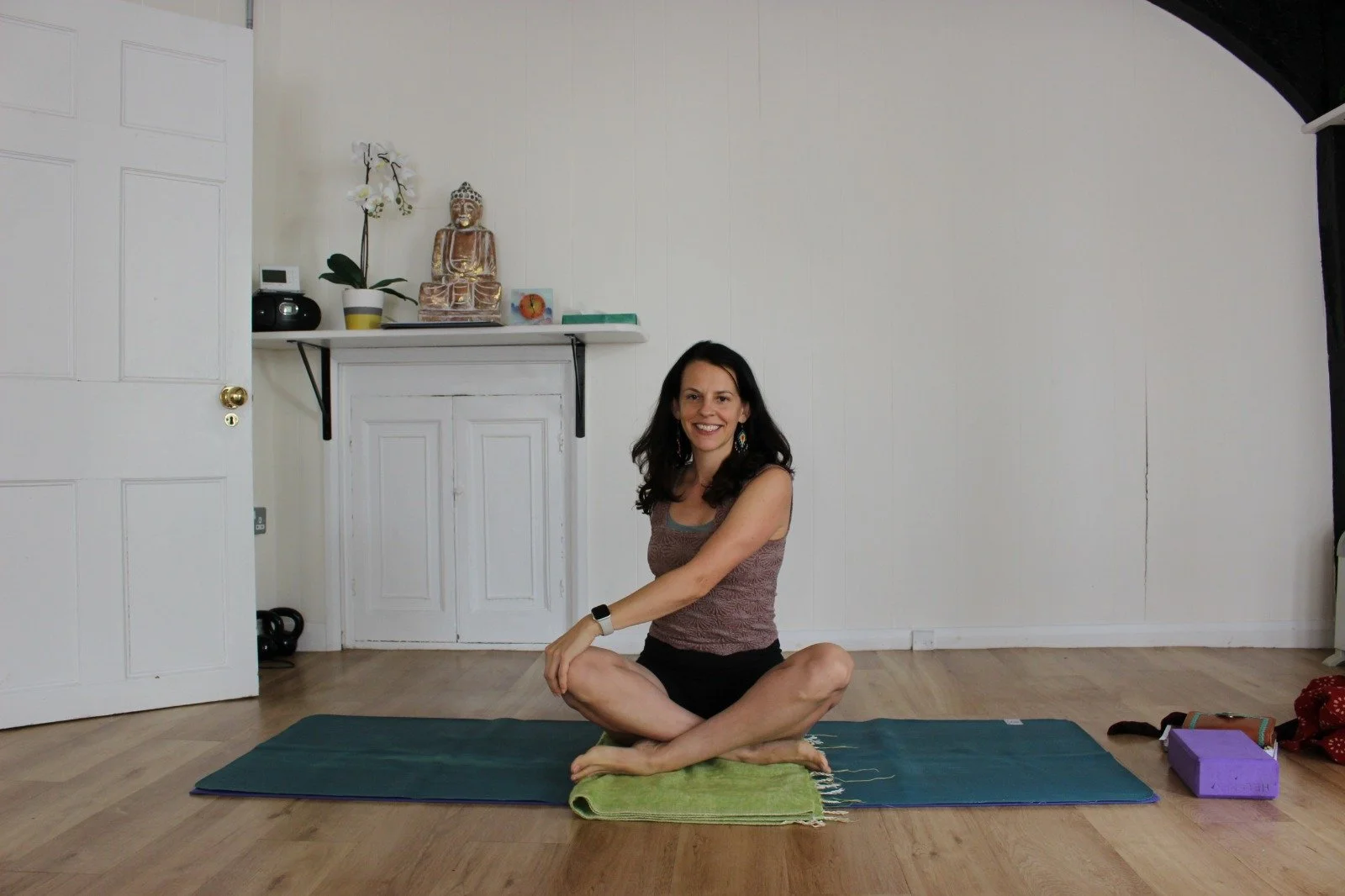
Why I love Kundalini Yoga
I think one of the reasons I fell in love with Kundalini is that it offers something quite different from the way we're often encouraged to approach exercise.
It's not about achieving the perfect posture, being particularly flexible or making your body look a certain way. In fact, some of the movements might look a little unusual!
Instead, the invitation is to participate, to experience and to notice.
There are moments when a practice feels physically challenging, moments when it feels meditative, and moments when chanting or breathing together can feel unexpectedly emotional.
Perhaps this is one of the things I value most about Kundalini. It invites us to move beyond our usual patterns and expectations. We don't always get to choose how a practice makes us feel, and we don't need to judge or analyse every experience. Sometimes we simply need to show up, get curious and see what unfolds.
I also love that I don't necessarily need to understand everything that's happening to benefit from the experience. Sometimes I simply show up, follow the practice and allow myself to be immersed in it.
I always come back to the idea that yoga is about how we feel, not simply how we look.
And Kundalini reminds me of that in a particularly beautiful way.
Is Kundalini Yoga suitable for beginners?
Absolutely. You don't need to have practised yoga before, be particularly flexible or have any experience of meditation.
Kundalini can be quite different from what you might expect, so I always encourage people to come with an open mind and a willingness to try something new.
Some breathing techniques and movements can be quite vigorous, so it's important to work within your own capacity. You can always slow down, modify a movement or take a break. There is no need to push yourself through anything that doesn't feel right.
If you're pregnant, have a relevant health condition or are unsure whether particular breathing practices are suitable for you, it's worth speaking with your healthcare professional and letting your teacher know before class.
The most important thing is that you feel comfortable exploring the practice in your own way.
experience it for yourself
If you're curious about Kundalini, I'd love you to come along and give it a try. I teach a weekly Kundalini class at The Courtyard Centre in Biggleswade, Bedfordshire. It's a welcoming space, and those who are completely new to the practice are very much encouraged to join us.
You don't need to know the mantras, understand the kriyas or have any previous experience. Just bring yourself, an open mind and a little curiosity.
You might discover, as I have, that there's something rather special about this practice.
I hope to see you on the mat.
With love,
Bea x

Hi, I’m Bea…
I help sensitive, purpose-driven women feel safe to rest, receive & thrive.
Through holistic coaching and restorative retreats, I help sensitive, purpose-driven women to slow down, reconnect with themselves and create a life that feels deeply aligned with who they are.
Because when your body remembers that it's safe, rest becomes possible. And from there, everything changes.
Enjoyed this article? You may also like:
7 Best Yoga Poses for Female Hormones: Supporting Your Body Through Perimenopause
The Reinvention Years: Why Women Redefine Their Lives in Their 40s
Why Do I Keep Waking Up at 2am? TCM, Perimenopause and the Mystery of Sleep
Perimenopause: A Journey of Rest, Reflection and Reconnection
Perimenopause, Ovulation and Mood Swings: Understanding the Day 12 Crash
Cyclical Living for Women: How to Work With Your Natural Rhythms